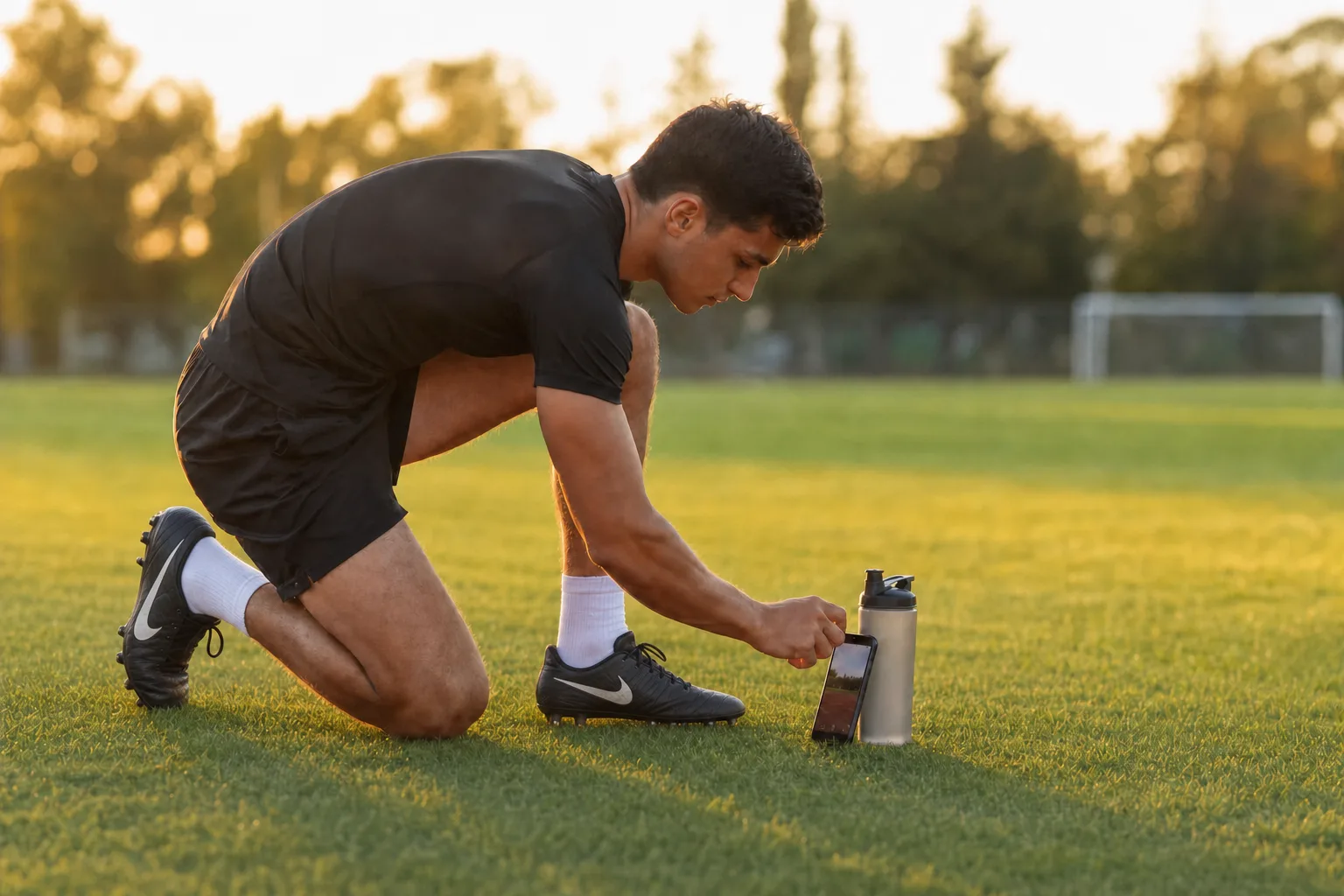
Most amateur athletes train with nobody watching. You run your sprints, hit the tackle bag, kick at the posts, and the only feedback you get is whether it felt right. This guide is about giving yourself usable technique feedback with the phone in your pocket and an AI analysis, and about where that approach stops working.
Nothing here needs special gear. It needs a phone, something to hold it still, a few minutes after training, and the discipline to film the same skill the same way every time. Do that and you can see your own technique the way a coach would, and track it over weeks instead of guessing.
Step 1: Film yourself properly
AI analysis is only as good as the clip. A model that cannot see your feet cannot judge your leg drive. Before you worry about what to look for, get the recording right. The distances and angles below are general best practice for filming sport technique, not a fixed rule; in ATHLAITE the app shows you the angle and distance for each drill on screen, so you do not have to measure anything.
- Whole body in frame, head to feet, for the entire movement. If your feet leave the frame during the kick, the analysis loses the plant foot.
- Phone at roughly hip height and stable. Lean it against a bag or clip it to a tripod. A hand-held clip shakes and the joint tracking drifts.
- Pick the angle for the skill: side-on for kicking and sprinting, about 45 degrees from the front for tackling and passing, so shoulders and hips are both visible.
- Landscape, not portrait. It fits the full run-up and follow-through without cropping.
- About 5 to 10 metres of distance, so the whole movement fits without the camera moving.
- Good light, no backlight. Filming into the sun turns you into a silhouette and the model cannot find your joints.
- Three to five reps per clip. One rep is a snapshot; five show the pattern.
- A second phone for a second angle helps. Front-on plus side-on catches things one angle hides.
Film the same way every session. Same spot, same distance, same angle. Consistency is what makes week three comparable with week one.
Step 2: Know what to look for
An analysis returns numbers, but you still need to know what those numbers mean for your sport. Here is what a coach, or the analysis, looks for in the four rugby skills ATHLAITE covers. Use it as a checklist when you watch your own clip back.
Tackle
Body height going into contact: low, with the hips under the shoulders, not bent at the waist. Head position to the side of the ball carrier, never in front. Shoulder contact, with the same-side foot close to the target. Leg drive after contact: short steps that keep pushing instead of stopping on impact.
Kick
Plant-foot position beside the ball, pointing where you want it to go. Hip rotation that starts the swing, not the knee. Contact point on the foot and on the ball. Follow-through that carries the leg through the line of the kick instead of stopping at the ball.
Sprint
Knee drive up and forward, not just cycling behind you. Arm swing from the shoulder, elbows at roughly a right angle, hands moving from hip to chin. Ground contact under the hips, not out in front, which brakes every stride. A slight forward lean from the ankles while you accelerate.
Ruck
Entry angle through the gate, from behind the ball, not from the side. Body height low enough to get under the opposition but high enough to stay on your feet. Footwork before contact: short steps and a wide base, so you arrive balanced rather than diving in.
Contact skills carry injury risk. Practise tackling and rucking under qualified supervision, within the tackle-height law and age-grade rules that apply to you, and never train contact through pain. ATHLAITE's analysis describes movement; it is not medical advice and does not assess whether contact is safe or legal.
Other sports
The same principle applies outside rugby. A football shot is plant foot, hip rotation, contact point and follow-through. A tennis serve is toss height, shoulder rotation, contact point and timing. Joints, angles and timing are what every technique breaks down into, which is why one analysis approach can cover more than one sport. ATHLAITE starts with rugby and more sports will follow.
Step 3: How AI analysis works, in plain terms
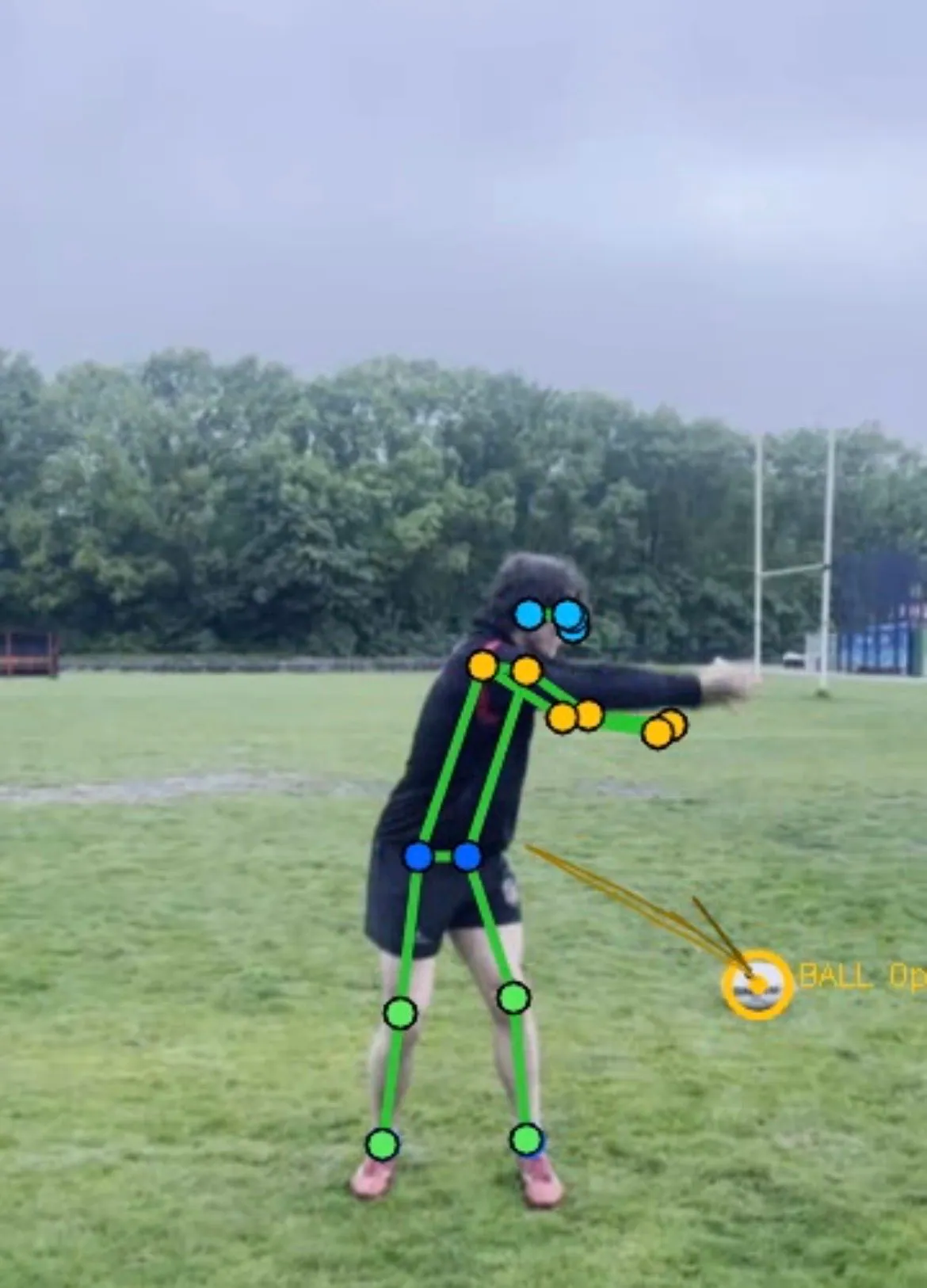
Strip away the marketing and AI technique feedback is computer vision on an ordinary phone video. A pose estimation model finds your body in every frame and marks the joints: ankles, knees, hips, shoulders, elbows, wrists, head. From those points it measures what a coach would estimate by eye, such as the knee angle at ground contact, the hip rotation before the kick, or how long your plant foot is down.
Those measurements are compared with what good technique looks like for that skill. The result comes back as a score, the weak points named, and drills that target them. In ATHLAITE that means a frame-by-frame breakdown, a score per session, and drills matched from a library of over 350 rugby drills. The analysis takes about a minute, so you can film, upload and adjust within the same session.
Seeing your own movement, not just hearing about it, matters more than it sounds. A 2022 systematic review in the German Journal of Exercise and Sport Research screened over 2,000 studies and concluded that video-based visual feedback supports motor learning in physical education, and appears more effective than verbal feedback on its own. A 2021 review in Cureus describes visual feedback as the cornerstone of all feedback types and notes that combined stimuli, such as seeing the clip and reading the correction, are picked up faster and retained longer than a single one.
Step 4: Turn feedback into a plan
A score is not a plan. The mistake most self-coached athletes make is trying to fix everything the analysis flags at once. Do not. Pick one or two focus points, the ones that show up in every rep, and work on those for a block of one to two weeks.
- Pick the weak point that costs you most. In a tackle that is usually body height; in a sprint, ground contact in front of the hips.
- Do the drill that targets it, two or three sessions a week.
- Film the skill again the same way, after the drill block, not after every single rep.
- Compare the clips side by side over weeks, not days. Technique changes slowly and a single bad session tells you nothing.
The reason not to check after every rep comes straight from motor-learning research. A 2010 review in Medical Education by Wulf, Shea and Lewthwaite lists four factors that reliably improve motor skill learning: observational practice, where the learner directs their attention, feedback, and self-controlled practice, where the learner decides when to get feedback. Its summary: practice in which the learner controls when feedback arrives has been found more effective than practice where someone else controls it. The same review reports that instructions aimed at the effect of the movement, such as where the ball should go, work better than instructions aimed at body parts. So once the analysis has told you your hips are high, train the outcome in the drill rather than reciting the checklist mid-rep.
The limits of AI feedback
This works well, but be clear about what it cannot do.
- It needs to see the movement. Blur, a teammate walking through the frame, or your body turned away from the camera all cost accuracy.
- One phone gives a 2D view. Rotation towards or away from the camera is estimated, not measured. A second angle helps but does not turn your pitch into a lab.
- It measures, it does not know why. The analysis can tell you your hips are high in the tackle. It cannot tell you whether that is habit, fear of contact, or a sore back.
- It cannot see game context. A clip of a drill says nothing about your decisions under pressure, about the 70th minute when you are tired, or about whether you should be training at all.
- It does not see fatigue or injury. A drop in score might be technique, or it might be that you are carrying something.
Treat the numbers as a second set of eyes on your technique, not as a verdict on you as a player.
When you still need a coach
Technique is only one layer. A coach reads the game with you, decides what to work on this month and what to leave, spots the injury you are not mentioning, and keeps you going when the score stalls. AI does none of that.
The best setup is not one or the other. A coach who sees the data from every session, not just the one they happened to watch, coaches better. That is why ATHLAITE has a dashboard for coaches and clubs: the player films, the analysis runs, and the coach sees who is improving and who needs attention across the whole squad. If you train without a coach right now, the data gets you most of the way. If you get one later, hand them the history.
Frequently asked questions
Do I need a tripod?
No. A bag, a bottle or a fence post works as long as the phone is still and at roughly hip height. A tripod only makes it easier to reproduce the exact setup next time.
How many reps should I film?
Three to five per clip. Fewer and you might just catch a bad one; more and the file gets large without adding much.
Can I use old footage?
Yes, if the clip meets the basics: whole body in frame, stable camera, one skill clearly visible. Match footage filmed from the stands usually does not work well because you are small in the frame and other players get in the way.
If you want to try it yourself, ATHLAITE is not in the app stores yet. Join the waitlist and see what the analysis says about your tackle, kick, sprint or ruck.
Keep reading
Sources
- Mödinger, M., Woll, A., & Wagner, I. (2022). Video-based visual feedback to enhance motor learning in physical education: a systematic review. German Journal of Exercise and Sport Research, 52, 447–460.
- Moinuddin, A., Goel, A., & Sethi, Y. (2021). The Role of Augmented Feedback on Motor Learning: A Systematic Review. Cureus, 13(11), e19695.
- Wulf, G., Shea, C., & Lewthwaite, R. (2010). Motor skill learning and performance: a review of influential factors. Medical Education, 44(1), 75–84.