How AI is changing sports coaching
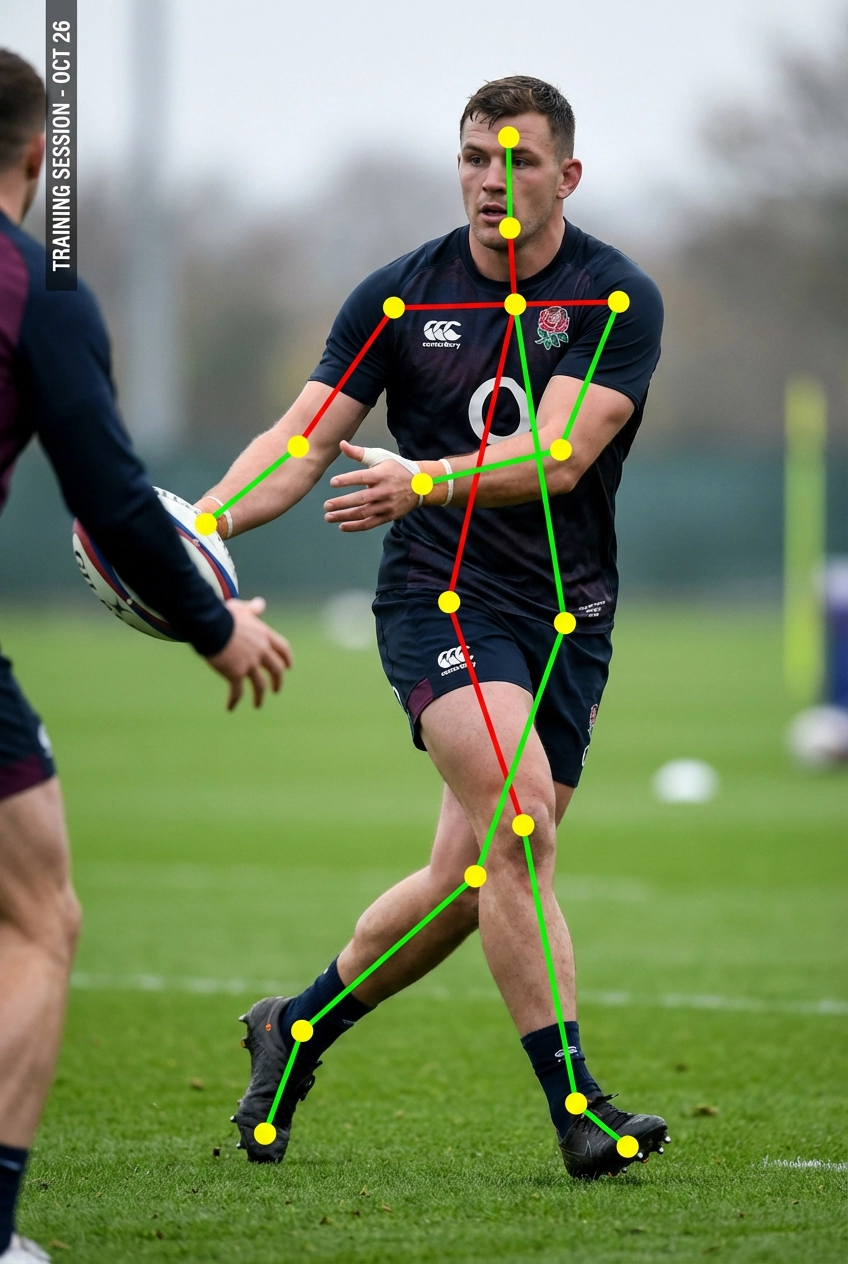
For most of the history of sport, technique feedback depended on one thing: a trained eye watching you at the moment you moved. If that eye was not there, the rep went uncorrected. AI is starting to change that, not by replacing the coach, but by making sure every rep gets seen.
In our first article we looked at the elite divide: around 29 million people in Germany do sport, roughly 606,000 coaches look after them, and individual feedback is mostly reserved for the top tier. This piece is about the tool that can close part of that gap, and about what it can and cannot do.
What AI coaching actually does today
Strip away the marketing and AI coaching is computer vision applied to ordinary phone video. An athlete films a pass, a kick or a tackle. A model finds the body in every frame and tracks the joints: hips, shoulders, elbows, wrists, knees, ankles. From those points it measures what a coach would estimate by eye, such as arm extension, shoulder rotation or how stable the stance is at the moment of release.
The measurements are compared with what good technique looks like for that skill, and the result comes back as a score, a few concrete corrections and drills that target the weak points. That is what ATHLAITE does for rugby technique: film a pass on your phone, get a frame-by-frame breakdown, work on the right drill next.
What changes for athletes
The biggest change is frequency. An athlete who trains three times a week and sees a coach once a month gets feedback on a fraction of their reps. With analysis on their phone, every filmed session becomes a feedback session. Mistakes get caught in the week they appear, not at the next camp.
The second change is access. The reasons most athletes never get individual coaching are money and availability: a personal trainer in Germany typically charges 60 to 120 euros per hour, according to the tutoring marketplace Superprof, and there is one coach for roughly every 47 athletes. Software does not fix either problem entirely, but it moves the first, most repetitive layer of feedback, such as "your elbow drops before release", from a scarce resource to something every player can have.
What changes for coaches
Coaches do not lose their job to this. They lose the part of it they never had time for. Nobody can watch 23 players' passing technique in a single session. With every player's uploads analysed, a coach opens the dashboard and sees who is improving, who has plateaued and who needs attention, across the whole squad, not just the players they happened to watch.
Planning changes with it. Instead of building next week's session from memory, a coach starts from measured weak points and picks drills that address them. Development becomes something you can show: to the player, to parents, to the board.
What AI does not replace
A model can tell you the angle of a shoulder. It cannot tell you why a player is hesitating, that they are carrying an injury they have not mentioned, or that their confidence collapsed after last weekend's match. It does not run a team talk, read a game or build trust. That remains coaching.
The honest way to think about AI in sport is a second set of eyes that never gets tired and never misses a rep, feeding a human who decides what matters. Where it is used that way, it makes coaches better, not redundant.
Where this is heading
The first wave of AI coaching is individual: one athlete, one phone, one skill. The next is organisational. When a whole club analyses every player the same way, technique standards become comparable across teams and age groups, talent shows up in the data before it shows up in a match, and federations can see development at a scale no scouting network could cover.
That is the direction we are building in. Elite-level analysis used to depend on an elite budget. It should depend on a phone and a willingness to film.
Keep reading